SINGAPORE (AP):- Vietnam’s leader said Friday that the Strait of Hormuz has shown how one flashpoint can throw the rest of the world into turmoil, suggesting that the U.S. and China need to abide by international law to avoid provoking a global crisis as they vie for influence in the Asia-Pacific region.
Vietnamese leader To Lam was delivering the keynote address at the Shangri-La Dialogue, Asia’s premier defense summit, to an audience that included U.S. Defense Secretary Pete Hegseth and a high-level delegation from China. Lam suggested that Iran’s stranglehold on the Strait of Hormuz during the war in the Middle East has demonstrated how regional conflicts can have worldwide ramifications.
“Recent tensions along strategic maritime routes in the Middle East remind us that a single flashpoint can rapidly disrupt trade, energy supplies, logistics and social economic life across the globe,” the Vietnamese leader said.
Vietnam navigates a delicate superpower balance
Lam has consolidated his power in Vietnam this year, becoming both Communist Party general secretary and president of the strategically important Southeast Asian nation, departing from its tradition of shared leadership.
Like several other countries in the region, Vietnam has competing maritime claims with Beijing that have led to confrontations, but at the same time is heavily tied economically to China, its biggest two-way trade partner.
The U.S., meantime, is Vietnam’s largest export destination and has been seeking to make diplomatic inroads and expand defense contracts to try and pull some of that market away from Hanoi’s traditional partner, Russia.
Recently leaked documents showed, however, that even after elevating relations with Washington to the highest diplomatic level, Vietnam’s military remained skeptical of American intentions and had taken steps to defend against a possible American “war of aggression.”
“This is the world’s most dynamic center of growth, but also a theater of intense strategic competition, a region defined by vital maritime routes, yet fraught with risk,” Lam told the gathering of world leaders, diplomats and top defense officials.
He said the region has “benefited profoundly from globalization,” but at the same time now faces mounting pressure on many fronts.
“What the region seeks is nether the mere presence nor absence of any major power, what it seeks is responsible commitment,” he said. “We recognize that competition is an enduring reality of international relations, but competition must be bound by law, guided by transparency and exercised with restraint.
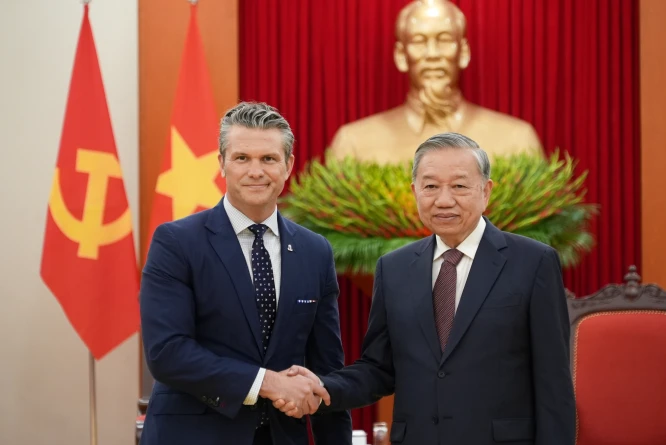
At a meeting with Lam and Vietnam’s defense minister ahead of Lam’s speech, Hegseth “applauded Vietnam’s rapid military modernization, which will strengthen Vietnam’s ability to defend its sovereignty and our shared interests,” according to a statement from the Pentagon.
Questions about US commitments
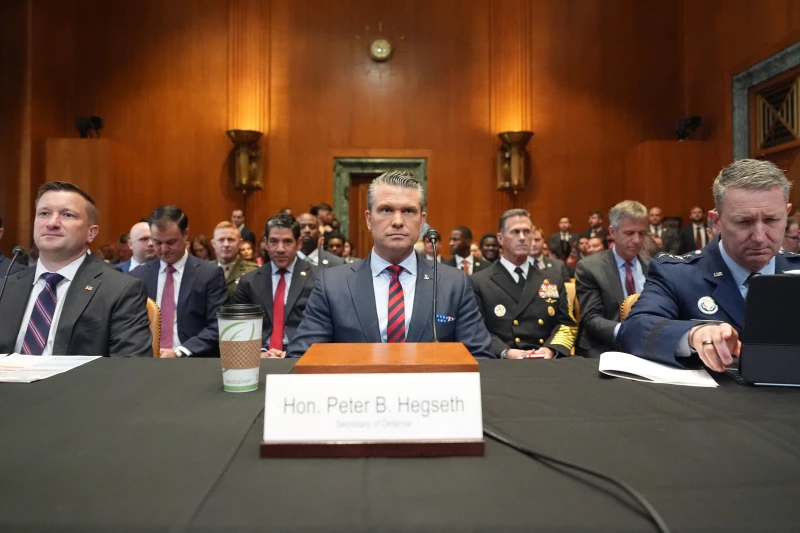
Hegseth, who will be making his second appearance at the event, was due to speak on Saturday morning. Last year in Singapore, Hegseth raised the ire of Beijing by saying “ the threat China poses is real, and it could be imminent,” and that its military was “rehearsing for the real deal.”
Hegseth said Washington would bolster its defenses to counter what the Pentagon sees as rapidly developing threats, particularly in China’s aggressive stance toward Taiwan.
But this year’s speech comes only about two weeks after U.S. President Donald Trump visited Chinese leader Xi Jinping in Beijing, where Xi warned that their two countries could clash over Taiwan if the issue was not handled properly.
Following the meetings, Trump called Xi a “great leader” and said that they were going to have a “fantastic future together.” Trump also raised questions about Washington’s willingness to defend Taiwan, calling a new $14 billion arms package that he has yet to greenlight “a very good negotiating chip for us” with China.
China claims the self-governing democratic island as its own, and Xi has not ruled out using force to take it.
The U.S., meantime, supplies Taiwan with modern aircraft, missiles and other weapons to help it defend itself, though follows a policy of “strategic ambiguity” on whether it would intervene militarily if China were to attack the island.
Trump has shown greater ambivalence toward Taiwan than his predecessors, fueling speculation about whether the president could be persuaded to dial back American support.
Hegseth’s speech will focus on the military’s “common-sense approach to safeguarding U.S. vital national interests in the Indo-Pacific,” according to the Pentagon.
Coming so soon after the meeting of the two leaders in Beijing, it seems unlikely Hegseth will say anything to upstage Trump’s own remarks.



Comments