KATHMANDU:- The Nepal Policy Institute (NPI), a global think tank promoted by the Nepali diaspora, hosted an invite-only focused policy discourse on 26 May 2026 in the context of Nepal’s ongoing debate on amendments to the Non-Resident Nepali Act, 2064. The discussion brought together legal experts, diaspora policy scholars, practitioners, entrepreneurs, migration experts, and civic leaders to examine how Nepal can use the present legislative moment not only to amend the existing NRN Act, but also to develop a more strategic, future-oriented framework for engaging Nepalis abroad.
The discourse was organized in the context of Nepal’s current debate on legal reforms concerning Non-Resident Nepalis, citizenship continuity, NRN rights, investment, knowledge transfer, and broader diaspora engagement. Participants noted that the existing legal framework has created both opportunities and confusion. While the NRN Act has provided a basis for recognizing certain categories of Nepalis abroad, the discussion emphasized that Nepal now needs a clearer and more comprehensive legal architecture that recognizes the diversity of Nepalis living outside the country.
 The program featured expert presentations from Dr. Khagendra Raj Dhakal, Founder and Chair of NPI and Professor at KMUTNB, Thailand; Prof. Bineet Sharma, University of California Santa Cruz Extension; Dr. Narayan Ghimire, Senior Advocate, Supreme Court of Nepal; Dr. Shree Krishna Bhattarai, former Judge; Mr. Basudev Ghimire, California-based entrepreneur and advocate for continuity of citizenship by descent; and Dr. Prabhat Adhikari, returnee practitioner and Rastriya Swatantra Party Founding Central Committee member. The discussion was jointly moderated by Ms. Nisha Thapa, Board Chair of GHAR — Global Health Advocacy and Research, and Prof. Bineet Sharma.
The four-hour presentation and focused group discussion, held virtually via Zoom, also brought together invited participants with diverse expertise and lived experience. They included Ms. Sharu Joshi, NPI Board Member and migration expert based in Kathmandu; Mr. Kedar Neupane, NPI Board Member, former UNHCR official, and migration and refugee expert based in Switzerland; Mr. Manoj Singh, artist and citizenship-by-descent advocate based in California; Dr. Prahlad Karki, NPI Expert Community Member and economist based in Kathmandu; Dr. Topraj Gurung, a returnee technology professional currently based in Kathmandu who has previously worked with Google, Internet.org at Facebook, and two startups; and Mr. Jay Dahal, Silicon Valley–based healthcare professional and Executive Board Member of the Global Nepali Professional Network (GNPN). They shared valuable comments, reflections, and suggestions both during and after the discussion.
A central outcome of the discourse was the recognition that Nepal should treat the current NRN Act amendment debate as a strategic policy window. Participants emphasized that the question
before Nepal is not merely how to fix gaps in the NRN Act, but how to redefine the relationship between Nepal and Nepalis abroad for the next generation.
Presenting NPI’s policy perspective, Dr. Khagendra Raj Dhakal argued that the Government of Nepal should move beyond a narrow amendment approach and consider developing a comprehensive Nepalis Abroad Engagement Policy, followed by a dedicated Nepalis Abroad Act. He emphasized that Nepalis abroad should be understood as an extended national asset for at least five major reasons: trust and belonging, economic confidence, knowledge transfer, next-generation ties, and Nepal’s global reach.
Dr. Dhakal proposed that the Government of Nepal has two possible policy tracks. The first is a limited reform track, involving amendments to the existing NRN Act and the Citizenship Act, 2063. The second is a more strategic reform track, involving constitutional review where necessary, including Article 14, alongside the development of a comprehensive Nepalis Abroad Engagement Policy and a dedicated Nepalis Abroad Act. Dr. Dhakal recommended that Nepal pursue the second track so that diaspora engagement is framed not only as a legal or citizenship issue, but also as a national development, knowledge diplomacy, investment, and global-network strategy.
 Proposed Recognition Framework under the Nepalis Abroad Policy and Act
A key contribution of the policy discourse was the proposal to move beyond the narrow and often confusing use of the term “NRN” and adopt a clearer umbrella policy language: “Nepalis Abroad.” Presenting this vision, Dr. Dhakal argued that a future Nepalis Abroad Engagement Policy and Nepalis Abroad Act should recognize Nepalis abroad through a three-category framework, with precise legal subcategories where necessary.
Under this framework, the term “Nepalis Abroad” would serve as the broad policy umbrella, while legal distinctions would be made depending on citizenship status, constitutional provisions, and the nature of engagement with Nepal. The proposed three categories are:
First, Nepali citizens residing abroad. This category includes migrant workers, students, professionals, and other Nepali citizens temporarily or permanently living outside Nepal. Participants emphasized that this group should be protected primarily as Nepali citizens abroad, not merged into a broad and confusing NRN label. Their policy needs include labour rights, consular support, social security, reintegration, legal protection, and external voting rights.
Second, Nepalis abroad who have acquired foreign citizenship. This category includes individuals who originally held Nepali citizenship but later acquired foreign citizenship. The discourse noted that this group requires clear legal treatment regarding citizenship continuity, identity, property, investment, inheritance, dignified belonging, and long-term connection with
Nepal. This category is especially important in the current debate on citizenship by descent, NRN citizenship, and possible amendments to the Citizenship Act and constitutional provisions.
Third, Persons of Nepali Origin abroad, or PNOs. This category includes Nepali-origin descendants and later generations abroad who may not hold, or may never have held, Nepali citizenship, but retain ancestral, cultural, linguistic, emotional, professional, or developmental ties with Nepal. This category should also recognize historically settled Nepali-origin and Nepali-speaking communities in countries such as Myanmar/Burma, Fiji, Thailand, Bhutanese Nepali-descendant communities, and other parts of the world, many of whom maintain Nepali language, culture, memory, and identity across generations without necessarily having formal citizenship links with Nepal. The proposed Nepalis Abroad Act could recognize this group through a PNO connection framework, including PNO cards, cultural and language connection, heritage learning, knowledge transfer, investment opportunities, next-generation engagement, and institutional channels for maintaining long-term ties with Nepal.
Participants agreed that such a three-category framework would help Nepal avoid policy confusion. It would allow the government to protect migrant workers and citizens abroad as citizens; clarify the rights and status of those who acquired foreign citizenship; and create meaningful channels for engaging second, third, and later generations of Nepali origin. This would also help ensure that the proposed Nepalis Abroad Act becomes a long-term legal architecture for diaspora engagement, rather than a narrow amendment to the existing NRN framework.
The discourse further emphasized that, where the current constitutional language requires the distinction of “outside SAARC,” the law can use the more precise formulation “Nepalis Abroad Outside SAARC” for legal purposes. However, at the broader policy level, “Nepalis Abroad” should be used as the inclusive umbrella term.
Diaspora as Nepal’s Strategic Asset: Evidence from Speakers
Other speakers further reinforced Dr. Dhakal’s five-part value proposition that citizenship continuity and diaspora engagement should not be viewed only as a diaspora demand, but as a state-interest issue for Nepal. Dr. Dhakal’s framework identified five reasons why Nepalis abroad should be recognized as an extended national asset: trust and belonging, economic confidence, knowledge transfer, next-generation ties, and global reach. The core message was that continuity of legal belonging is a national asset-retention strategy.
Prof. Bineet Sharma presented a data-driven case for viewing the Nepali diaspora as a global growth asset. His presentation noted that Nepalis abroad represent an estimated 3 million-strong global footprint, roughly equivalent to 10% of Nepal’s domestic population. He highlighted that remittances reached approximately NPR 1,445.3 billion, or US$10.86 billion, in FY
2023/24, amounting to 25.3% of GDP. However, his core argument was that remittance-based household consumption alone cannot generate the compounding growth Nepal requires.
Prof. Sharma further showed that Nepal’s diaspora is increasingly skilled and knowledge-rich, with 69.5% of Nepali migrant workers in FY 2023/24 categorized as skilled, compared with 27.8% a decade earlier, and with 51% of Nepali Americans aged 25 and above holding a bachelor’s or advanced degree. These data strongly supported the economic confidence, knowledge transfer, and global reach dimensions of Dr. Dhakal’s framework.
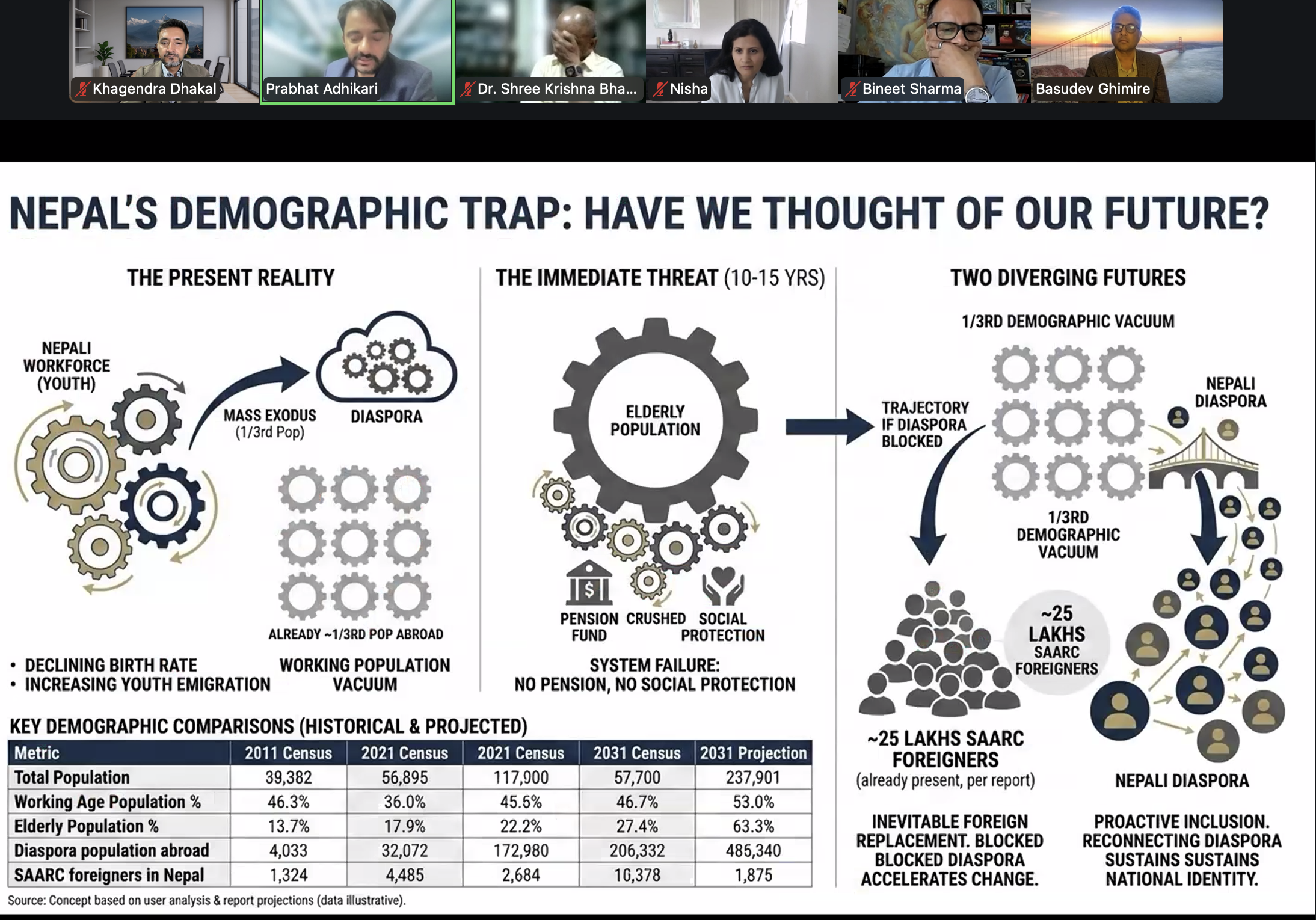
Dr. Prabhat Adhikari reinforced the argument from the perspective of Nepal’s demographic future and the practical limitations of the current NRN citizenship framework. His presentation framed the issue as “Nepal’s demographic shift: a stark picture” and highlighted Nepal’s declining fertility rate, from 2.51 children in 2011 to 1.85 children in 2021, already below the replacement level. He also pointed to slowing population growth and the scale of outward mobility, including 1.67 million total departures in 2024 alone.
Dr. Adhikari described this as part of Nepal’s emerging “demographic trap,” linking youth emigration, declining birth rates, possible workforce gaps, and future pressure on pension and social protection systems. He cautioned that if Nepal does not proactively reconnect its own diaspora, the emerging population and workforce vacuum may increasingly be filled by migration and labour flows from neighbouring countries. His point was not to frame neighbouring populations negatively, but to underline a strategic national question: whether Nepal will reconnect its own people abroad or allow demographic, economic, and identity gaps to widen over time.
He also argued that the current NRN citizenship provision has not been fully effective if Nepalis abroad continue to face foreigner-like procedures in investment and economic participation. He therefore emphasized that Nepal needs a long-term diaspora engagement vision that goes beyond symbolic recognition. For Nepal’s broader national interest, he called for stronger engagement with Nepalis of Nepali origin and descent, including serious consideration of the continuity of वंशजको नागरिकता where legally and politically feasible. His intervention directly supported the trust and belonging, economic confidence, next-generation ties, and global reach dimensions of Dr. Dhakal’s framework.
Mr. Basudev Ghimire, speaking as a California-based entrepreneur and advocate for the continuity of वंशजको नागरिकता, emphasized the economic case for citizenship continuity. He argued that the current NRN citizenship framework does not generate sufficient confidence if Nepalis who originally held citizenship by descent are expected to give up their full citizenship status and then face procedures similar to foreign nationals in investment, property, and economic participation.
As an illustrative example, Mr. Ghimire argued that if Nepalis abroad were encouraged to build around 100,000 houses in Nepal, this could inject a very large amount of capital into the domestic economy through construction, tax, VAT, employment, banking activity, and local enterprise growth. He suggested that, with citizenship continuity and trusted legal belonging, Nepal could mobilize its own diaspora as a more sustainable economic partner rather than relying mainly on foreign loans and grants. His core message was that legal belonging creates economic confidence: when Nepalis abroad feel secure in their citizenship, identity, property rights, and long-term relationship with Nepal, they are more likely to invest, return, contribute, and pass their connection to the next generation.
Taken together, these interventions showed that Nepal should not reduce diaspora engagement to remittances alone. Prof. Sharma’s evidence demonstrated the economic, professional, and knowledge potential of Nepalis abroad; Dr. Adhikari’s demographic analysis showed why diaspora connection is critical for Nepal’s future resilience; and Mr. Ghimire’s intervention highlighted why citizenship continuity and dignified belonging matter for economic confidence and intergenerational connection.
 Legal Perspectives and the Case for a Broader Nepalis Abroad Act
From the legal perspective, Senior Advocate Dr. Narayan Ghimire highlighted the limitations of what can be achieved through amendments to the NRN Act alone. He noted that the current consultation initiated by the Ministry of Foreign Affairs is primarily focused on amending the existing NRN Act. However, because the NRN Act is directly linked to the NRN citizenship provision under Article 14 of the Constitution, the wider aspirations of Nepalis abroad cannot be fully addressed through ordinary legislative amendment alone.
Dr. Ghimire explained that Article 14 operates as an independent controlling and guiding constitutional provision for persons of Nepali origin who have acquired foreign citizenship. Since Article 14 limits NRN citizenship mainly to economic, social, and cultural rights, no federal law can be made in contradiction to that constitutional provision. He therefore argued that questions related to the continuity or restoration of citizenship by birth or citizenship by descent for those who have acquired foreign citizenship may not be fully addressed unless Article 14 itself is amended or constitutionally reconsidered.
At the same time, Dr. Ghimire emphasized that the existing NRN Act requires substantial reform to allow NRNs to exercise their constitutional rights and privileges with greater openness, rather than through restrictive conditions. He also suggested that the Government could issue appropriate circulars or administrative instructions to remove current difficulties in transactions, investment, property, and other practical areas where NRNs face procedural barriers. In his view, the current amendment process can address some administrative and procedural problems, but it cannot fully respond to wider questions of citizenship continuity, political belonging, equal dignity, investment confidence, and long-term diaspora engagement.
This legal assessment strengthened the broader policy argument that Nepal needs a more comprehensive approach. If the goal is only to improve administrative procedures under the existing NRN framework, then reform of the NRN Act and related administrative circulars may help. But if the goal is to respond to the wider aspirations of Nepalis abroad and mobilize them as Nepal’s extended national asset, then Nepal requires a broader policy and legal architecture. This is where a Nepalis Abroad Engagement Policy and a dedicated Nepalis Abroad Act become necessary.
Similarly, former Judge Dr. Shree Krishna Bhattarai emphasized that Nepal’s approach to Nepalis abroad should not be based only on Article 14 of the Constitution, which provides a limited framework for NRN citizenship. In his view, the stronger constitutional and statutory basis for engaging many Nepalis abroad, especially those who originally held citizenship by descent, lies in Article 11(2)(a) and Article 11(2)(b) of the Constitution, read together with Section 3(1) of the Nepal Citizenship Act, 2063.
Dr. Bhattarai noted that these provisions recognize the principle of citizenship by descent. Article 11(2)(a) recognizes those who had acquired Nepali citizenship by descent before the commencement of the Constitution, while Article 11(2)(b) recognizes a person whose father or mother was a Nepali citizen at the time of that person’s birth. Similarly, Section 3(1) of the Nepal Citizenship Act, 2063 provides the statutory basis for citizenship by descent where a person’s father or mother was a Nepali citizen at the time of birth. Therefore, he emphasized that वंशजको नागरिकता should not be treated as automatically revocable merely because a Nepali citizen later acquired foreign citizenship.
In Dr. Bhattarai’s interpretation, Article 14 should be understood as a limited NRN citizenship provision, not as the sole constitutional basis for Nepal’s relationship with Nepalis abroad. If Nepal relies only on Article 14, the engagement framework remains confined to economic, social, and cultural rights and does not fully address the deeper questions of citizenship continuity, dignity, belonging, and intergenerational connection. He therefore suggested that the continuity of citizenship by descent could be clarified through appropriate amendments to the Nepal Citizenship Act, 2063, if there is political and legal consensus.
Dr. Bhattarai’s remarks also point toward the need for a broader reform vision. The proposed Nepalis Abroad Engagement Policy and Nepalis Abroad Act should therefore not be designed merely as an extension of Article 14. They should also recognize the constitutional and statutory significance of citizenship by descent under Article 11 and Section 3(1) of the Nepal Citizenship Act, 2063, and create a coherent legal pathway for Nepalis abroad who seek to maintain a dignified and continuing legal bond with Nepal.
In this sense, the interventions of Senior Advocate Dr. Narayan Ghimire and former Judge Dr. Shree Krishna Bhattarai complemented the broader policy arguments presented by Dr. Khagendra Raj Dhakal, Prof. Bineet Sharma, Dr. Prabhat Adhikari, and Mr. Basudev Ghimire. Together, the legal and policy perspectives showed that the issue is not simply whether the NRN Act should be amended. The deeper question is whether Nepal is ready to build a long-term national framework for all Nepalis abroad.
Why a Nepalis Abroad Engagement Policy and Nepalis Abroad Act Are Needed
The discourse established a clear policy logic. Nepal’s existing NRN framework is too narrow to address the full reality of Nepalis abroad. It does not adequately distinguish between Nepali citizens residing abroad, Nepalis who acquired foreign citizenship, and Persons of Nepali Origin across generations. It also does not sufficiently connect citizenship, investment, labour protection, knowledge transfer, cultural continuity, and next-generation engagement.
A comprehensive Nepalis Abroad Engagement Policy would provide the broader vision for Nepal’s relationship with all categories of Nepalis abroad. A dedicated Nepalis Abroad Act would then provide the legal framework to operationalize that vision. Together, they would modernize Nepal’s relationship with its global population by recognizing Nepalis abroad as a strategic national asset.
This approach would allow Nepal to pursue two reform tracks together. The first track would involve immediate improvements to the NRN Act and Citizenship Act to address practical issues, administrative barriers, investment procedures, transaction difficulties, and legal uncertainty. Where possible, administrative circulars could also be issued to ease current barriers faced by NRNs in exercising their existing rights and privileges. The second track would involve a broader constitutional and policy review, including Article 14 where necessary, while also examining the citizenship-by-descent basis under Article 11 and Section 3(1) of the Nepal Citizenship Act, 2063, to address the larger question of citizenship continuity and full diaspora engagement.
This approach would help Nepal move from a fragmented NRN-focused framework to a coherent Nepalis Abroad policy and legal architecture. It would also align with Dr. Dhakal’s five-part argument that Nepalis abroad matter for Nepal because they strengthen trust and belonging, economic confidence, knowledge transfer, next-generation ties, and global reach.
Outcome Recommendations
The discourse concluded with the following recommendations:
1. The current NRN Act amendment debate should be treated as a strategic policy window, not merely as a routine technical amendment process.
2. The Government of Nepal should consider developing a comprehensive Nepalis Abroad Engagement Policy, followed by a dedicated Nepalis Abroad Act, to provide an umbrella policy and legal framework for all Nepalis abroad.
3. The Nepalis Abroad Engagement Policy should adopt “Nepalis Abroad” as the inclusive policy term and clearly distinguish among three groups: Nepali citizens residing abroad, Nepalis abroad who have acquired foreign citizenship, and Persons of Nepali Origin abroad.
4. Immediate amendments to the NRN Act and Citizenship Act should address procedural barriers, investment confidence, property-related clarity, transaction difficulties, and administrative obstacles. These amendments should also be supported, where appropriate, by government circulars or administrative instructions to remove current practical barriers, while remaining aligned with a larger Nepalis Abroad engagement vision.
5. The Government should initiate a broader constitutional and statutory review, including Article 14, Article 11, and Section 3(1) of the Nepal Citizenship Act, 2063, if Nepal intends to
address the wider aspiration for continuity of वंशजको नागरिकता and a stronger legal bond with Nepalis abroad.
6. Citizenship continuity should be treated not only as a legal or emotional issue, but also as a foundation for economic confidence, knowledge transfer, intergenerational identity, and long-term national development.
7. The Nepalis Abroad Act should include dedicated mechanisms for diaspora investment, entrepreneurship, housing and property investment, knowledge transfer, research collaboration, professional networks, philanthropy, cultural continuity, and next-generation engagement.
8. Nepali citizens currently residing abroad, including migrant workers, students, and professionals, should be protected as Nepali citizens abroad, with stronger provisions for labour rights, consular support, social security, reintegration, and external voting.
9. The Nepalis Abroad Act should create a meaningful framework for Persons of Nepali Origin, including historically settled Nepali-speaking and Nepali-origin communities, through cultural, linguistic, educational, heritage, and knowledge-connection mechanisms.
10. The Government, political parties, civil society, diaspora organizations, and knowledge institutions should create wider public and policy discussions at multiple levels to inform both the Nepali public and Nepalis abroad about the implications of citizenship continuity, NRN reform, and long-term diaspora engagement. Such discussions are necessary so that all political parties and the Government of Nepal can make informed, evidence-based, and nationally responsible decisions.
11. The Government should pursue this reform through a transparent, consultative, and evidence-informed process involving legal experts, diaspora professionals, migration experts, policymakers, civil society, think tanks, and representatives of Nepalis abroad.
Closing Statement
NPI believes that the ongoing NRN Act amendment should not be treated as an isolated legal exercise. It should be understood as part of a broader national policy agenda to engage Nepalis Abroad, including Nepali citizens living outside Nepal, NRNs, and people of Nepali origin, in Nepal’s long-term development, diplomacy, and global positioning.
NPI further recommends that future reforms related to the NRN Act, Citizenship Act, and constitutional amendment process be guided by a comprehensive Nepalis Abroad Engagement Policy. Such a policy can help Nepal move beyond fragmented legal responses and develop a coherent framework for protecting rights, strengthening identity, promoting investment, mobilizing knowledge, and deepening the relationship between Nepal and its global community.
“This is not merely a demand from the diaspora, but a constructive offer to work with the state to address a genuine national policy challenge,” said Dr. Khagendra Raj Dhakal, Founder and Chair of Nepal Policy Institute.
NPI remains committed to working constructively with the Government of Nepal, Parliament, political parties, civil society, and Nepalis Abroad to help shape an inclusive, practical, and future-oriented policy framework.





Comments