KATHMANDU:- Minister for Foreign Affairs Shishir Khanal has said that the Nepali community in Australia has played an important role in taking Nepal-Australia relations to new heights.
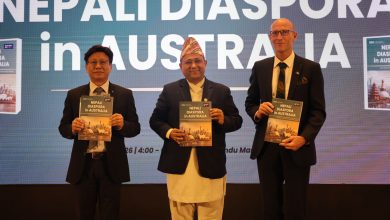
At a public event organized here in collaboration with the Institute for Integrated Development Studies (IIDS) and the Australian Embassy in Nepal to launch the report ‘Nepali Diaspora in Australia’, Minister Khanal informed that discussions are underway within the government to make the system of non-resident Nepali citizenship more effective.
He said that there are legal complications as there is no provision for dual citizenship in Nepal’s constitution and that efforts are being made to further strengthen relations with the diaspora within the existing legal framework.
Australian Ambassador to Nepal Simon Earnest stressed that the Nepali diaspora is not only a source of remittances but also an important network connecting Nepal to the world. He noted that the Nepali community is expanding its influence in Australia economically, socially and culturally. “The value of the diaspora is not limited to remittances alone, it has given Nepal the opportunity to expand global relations,” he said.
According to the report, the number of people of Nepali origin in Australia is estimated to have reached 213,580 by June 2025. This number is a significant increase compared to 2021. It is noted that 61.16 percent of the study participants went to Australia for higher education.
The study found that the Nepali community in Australia is active in the health, information technology, engineering, hospitality and financial sectors. According to the survey, 45.27 percent of respondents have an annual income between 65,000 and 120,000 Australian dollars.
IIDS Executive Chairman Dr. Biswas Gauchan said that remittances coming to Nepal account for more than 30 percent of the country’s gross domestic product and that the economic and intellectual contributions of the diaspora should be utilized effectively.
The report showed that 34.99 percent of respondents had made formal investments. However, the study stated that most of the investments were concentrated in Australia. Participants in the program said that policy stability, transparency, and an investment-friendly environment are necessary for expanding investment in Nepal.
Presenting the study, Sneha Ghimire, Senior Program and Research Assistant at IIDS, said that the role of the Nepali diaspora is not limited to remittances. According to her, the contribution of the Nepali community in investment, entrepreneurship, business relations, cultural exchange and knowledge transfer is increasing.











Comments