By WAFAA SHURAFA, DEIR AL-BALAH, Gaza (AP):- A pair of Israeli strikes in Gaza’s southern city of Khan Younis early Thursday killed five people, hospital officials said, bringing the death toll from airstrikes in the Palestinian territory over a roughly 12-hour period to 33. The strikes have been some of the deadliest since Oct. 10 when a U.S.-brokered ceasefire took effect.
The renewed escalation came after Israel said that its soldiers had come under fire in Khan Younis on Wednesday. Israel said that no soldiers were killed and that the military responded with strikes.
Four Israeli airstrikes on tents sheltering displaced people in Khan Younis late Wednesday and early Thursday killed 17 people, including five women and five children, according to officials at Nasser Hospital.
In Gaza City, two airstrikes on a building killed 16 people, including seven children and three women, according to officials at the Al-Shifa hospital in the northern part of the city where the bodies were taken.
The Hamas militant group condemned the Israeli strikes as a “shocking massacre.” In a statement, Hamas denied firing toward Israeli troops.
Palestinians mourn loved ones
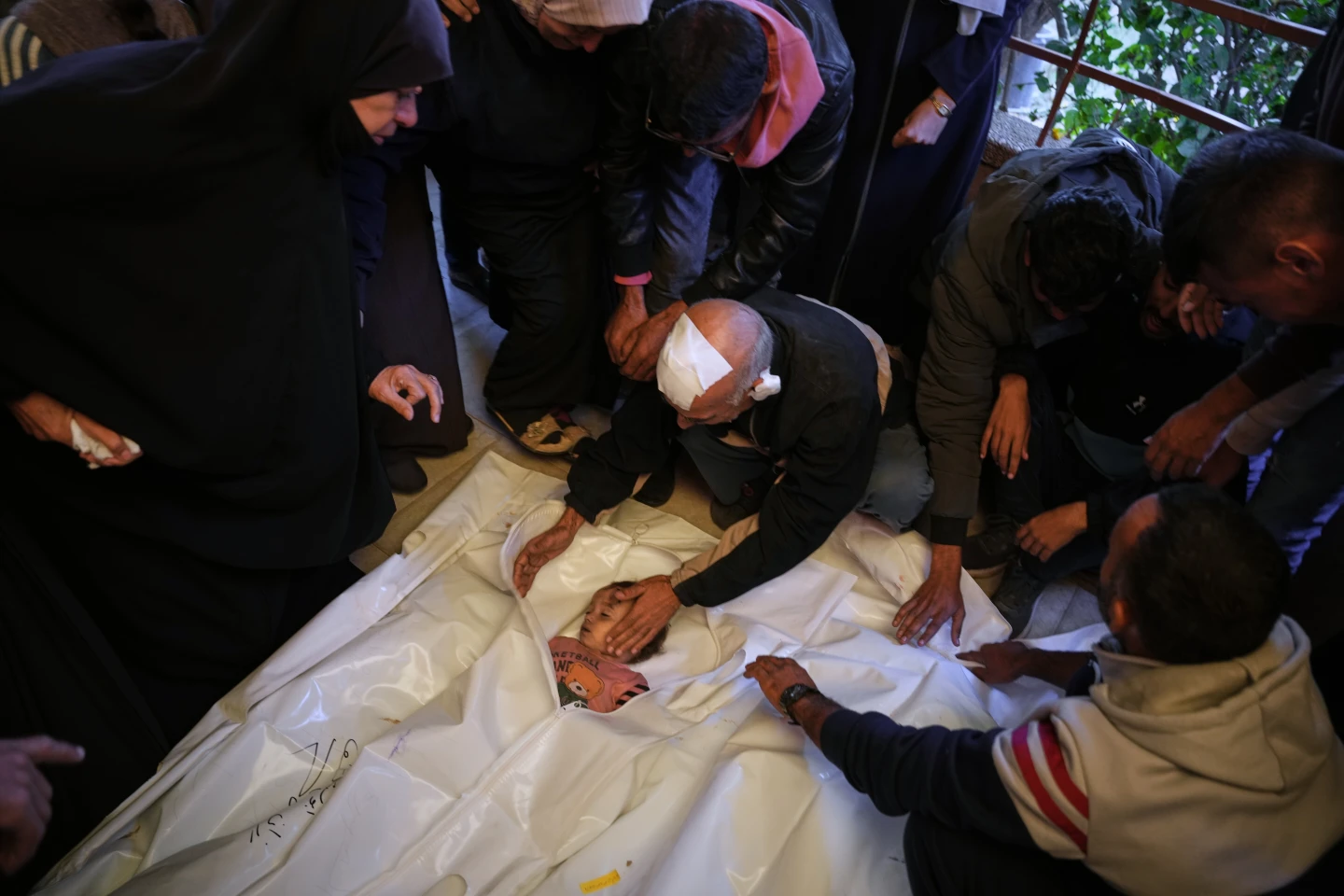
At Nasser Hospital, scores of people gathered to offer funeral prayers for those who were killed in the Israeli strikes. Women wailed in mourning over the bodies of loved ones wrapped in white burial shrouds.
Among the mourners was Abir Abu Moustapha, who lost her three children, ages 1, 11 and 12, and her husband in an Israeli strike on Wednesday that hit their tent. She squatted beside their bodies as they were prepared for burial.
“My children are gone. What can I say? And my husband, my most precious. May God have mercy on them,” Abu Moustapha said. “How was it my children’s fault that they had to die? Why was it their fault that they died in front of my eyes?”
Ceasefire again under pressure
Hospital officials said that the bodies came from both sides of a line established in last month’s ceasefire. The boundary splits Gaza in two, leaving the border zone under Israeli military control while the area beyond it is meant to serve as a safe zone.
The strikes came shortly after the U.N. Security Council gave its backing to U.S. President Donald Trump’s blueprint to secure and govern Gaza. The plan empowers an international force to provide security in Gaza, approves a transitional authority and envisions a possible future path to an independent Palestinian state.
But there are still questions over how the plan will be implemented, especially after Hamas rejected it. The militant group said that the force’s mandate. which includes disarmament, “strips it of its neutrality, and turns it into a party to the conflict in favor of the occupation.”
Israeli strikes have decreased since the ceasefire agreement took effect, though they haven’t stopped entirely.
Gaza’s Health Ministry, which doesn’t distinguish between civilians and combatants, reported more than 300 deaths since the truce began. Each side has accused the other of violating its terms, which include increasing the flow of aid into Gaza and returning hostages — dead or alive — to Israel.
The deaths are among the more than 69,000 Palestinians killed since Israel launched its sweeping offensive more than two years ago in response to Hamas-led militants killing around 1,200 people, mostly civilians, and abducting 251 people in the attack on southern Israel on Oct. 7, 2023, which triggered the war. Gaza’s Health Ministry, part of the Hamas-run government and staffed by medical professionals, maintains detailed records seen as a reliable estimate by the U.N. and many independent experts.
The remains of 25 hostages have been returned to Israel since the ceasefire began. There are still three more in Gaza that need to be recovered and handed over. Hamas returned 20 living hostages to Israel on Oct. 13.
Israel targets Hezbollah
The Gaza strikes coincided with a barrage of Israeli airstrikes in southern Lebanon on Wednesday on what the Israeli military said said were Hezbollah sites in the country, including weapons storage facilities. A day earlier, an Israeli airstrike killed 13 people in the Palestinian refugee camp of Ein el-Hilweh, the deadliest of Israeli attacks on Lebanon since a ceasefire in the Israel-Hezbollah war a year ago.
The Israeli military said that Hezbollah was working to reestablish itself and rebuild its capacity in southern Lebanon, without providing evidence. It said that the weapons’ facilities targeted were embedded among civilians and violated understandings between Israel and Lebanon. Israel agreed to a ceasefire and withdrew from southern Lebanon last year and Lebanon agreed to quell Hezbollah activity in the area.
Earlier Wednesday, an Israeli airstrike on a car in the southern Lebanese village of Tiri killed one person and wounded 11, including students aboard a nearby bus, the Lebanese Health Ministry and state media said. The state-run National News Agency said that the school bus happened to be passing near the car that was hit.
Israel’s military later said that it killed a Hezbollah operative in the drone strike.








Comments