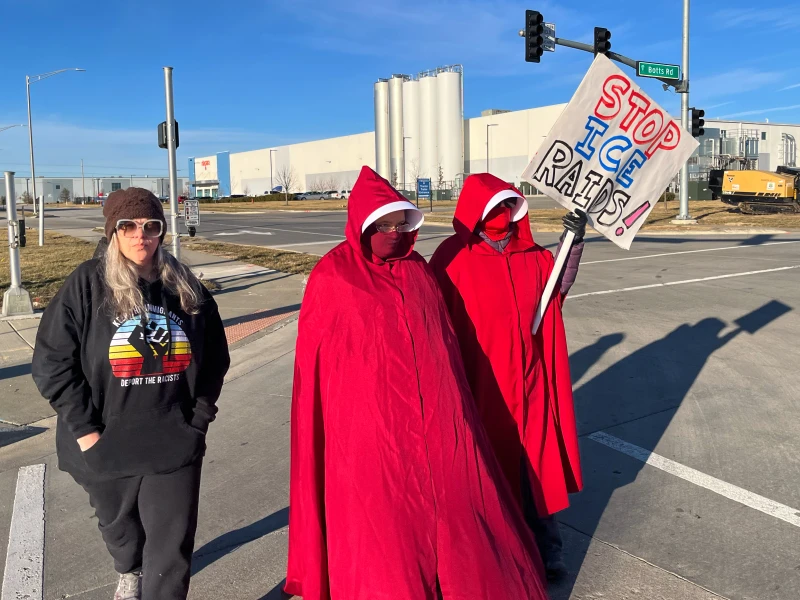
By DAVID A. LIEB, HEATHER HOLLINGSWORTH and MORGAN, NEW YORK, (AP):- With tensions high over federal immigration enforcement, some state and local officials are pushing back against the Trump administration’s attempts to house thousands of detained immigrants in jails, converted warehouses and privately run facilities in their communities.
Federal officials have been scouting cities and counties across the U.S. for places to hold immigrants as they roll out a massive $45 billion expansion of detention facilities financed by President Donald Trump’s recent tax-cutting law.The fatal shootings of Renee Good and Alex Pretti by immigration enforcement officers in Minneapolis have amplified an already intense spotlight on U.S. Immigration and Customs Enforcement, increasing scrutiny of its plans for new detention sites.
A proposed ICE facility just north of Richmond, Virginia, drew hundreds of people last week to a tense public hearing of the Hanover County Board of Supervisors.
“You want what’s happening in Minnesota to go down in our own backyard? Build that detention center here, and that’s exactly what will happen,” resident Kimberly Matthews told county officials.
As a prospective ICE detention site became public, elected officials in Kansas City, Missouri, scrambled to pass an ordinance aimed at blocking it. And mayors in Oklahoma City and Salt Lake City — after raising concerns about building permits — announced last week that property owners won’t be selling or leasing their facilities for immigration detention.
Meanwhile, legislatures in several Democratic-led states pressed forward with bills barring or discouraging ICE facilities. A New Mexico measure targets local government agreements to detain immigrants for ICE. A novel California proposal seeks to nudge companies running ICE facilities out of the state by imposing a 50% tax on their proceeds.
The number of ICE detention sites has doubled
More than 75,000 immigrants were being detained by ICE as of mid-January, up from 40,000 when Trump took office a year earlier, according to federal data released Tuesday.In a little over a year, the number of detention facilities used by ICE more than doubled, to 225 sites spread across a combined 48 states and territories. Most of that growth came through existing contracts with the U.S. Marshals Service or deals to use empty beds at county jails.
Trump’s administration now is taking steps to open more large-scale facilities. In January, ICE paid $102 million for a warehouse in Washington County, Maryland, $84 million for one in Berks County, Pennsylvania, and more than $70 million for one in Surprise, Arizona. It also solicited public comment on a proposed warehouse purchase in a flood plain in Chester, New York.
Federal immigration officials have toured large warehouses elsewhere, without releasing many details about the efforts.
“They will be very well structured detention facilities meeting our regular detention standards,” ICE said in a statement, adding: “It should not come as news that ICE will be making arrests in states across the U.S. and is actively working to expand detention space.”
Detention site foes face legal limitations
State and local governments can decline to lease detention space to ICE, but they generally cannot prohibit businesses and private landowners from using their property for federal immigrant detention centers, said Danielle Jefferis, an associate law professor at the University of Nebraska who focuses on immigration and civil litigation.In 2023, a federal court invalidated a California law that barred private immigrant detention facilities, finding it infringed on federal powers. A federal appeals court panel cited similar grounds in July while striking down a New Jersey law that forbade agreements to operate immigrant detention facilities.
After ICE officials recently toured a warehouse in Orlando, Florida, as a prospective site, local officials looked into ways to regulate or prevent it. But City Attorney Mayanne Downs advised them in a letter that “ICE is immune from any local regulation that interferes in any way with its federal mandate.”
Officials in Hanover County also asked their attorney to evaluate legal options after the Department of Homeland Security sent a letter confirming its intent to purchase a private property for use as an ICE processing facility. The building sits near retail businesses, hotels, restaurants and several neighborhoods.
Although some residents voiced concerns that an ICE facility could strain the county’s resources, there’s little the county can do to oppose it, said Board of Supervisors Chair Sean Davis.
“The federal government is generally exempt from our zoning regulations,” Davis said.
Kansas City tries to block a new ICE detention site
Despite court rulings elsewhere, the City Council in Kansas City voted in January to impose a five-year moratorium on non-city-run detention facilities. The vote came on the same day ICE officials toured a nearly 1-million-square-foot (92,903-square-meter) warehouse as a prospective site.Manny Abarca, a county lawmaker, said he initially was threatened with trespassing when he showed up but was eventually allowed inside the facility, where a deputy ICE field office director told him they were scouting for a 7,500-bed site.
Abarca is trying to fortify Kansas City’s resistance by proposing a countywide moratorium on permits, zoning changes and development plans for detention facilities not run by the county or a city.
“When federal power is putting communities on edge, local government has a responsibility to act where we have authority,” he said.
As other ICE proposals have surfaced, officials in Social Circle, Georgia; Merrillville, Indiana; El Paso, Texas; and Roxbury Township, New Jersey, have raised concerns about a lack of water and sewer capacity to transform warehouses into detention sites.
Officials in Leavenworth, Kansas, are seeking to hold private prison operator CoreCivic to its requirements. A city planning commission on Monday advanced a three-year permit that would be needed for CoreCivic to reopen a shuttered prison as an ICE detention facility capable of housing up to 1,000 detainees.
Nationally, it remains to be seen whether local governments can deter ICE facilities through building permits and regulations.
“We’re currently in a moment where it is being tested,” Jefferis said. “So there is no clear answer as to how the courts are going to come down.”
New Mexico targets existing ICE facilities
The Democratic-led New Mexico House on Friday passed legislation banning state and local government contracts for ICE detention facilities, sending it to the Senate. Similar bills are pending in Hawaii, Massachusetts, New York and Rhode Island.
The Otero County Processing Center, 25 miles (40 kilometers) from downtown El Paso, Texas, is one of three privately run ICE facilities that could be affected by the New Mexico legislation. The facility includes four immigration courtrooms and space for more than 1,000 detainees. The county financed its construction in 2007 with the intent to use it as a revenue source, and plans to pay off the remaining $16.5 million debt by 2028.
Otero County Attorney Roy Nichols said the county is prepared to sue the Legislature under a state law that prevents impairment of outstanding revenue bonds.
Republicans warned of job losses and economic fallout if the legislation forces immigrant detention centers to close.
But Democratic state Rep. Sarah Silva, who voted for the ban, and said her constituents in a heavily Hispanic area view the ICE facility as a burden.
“Our state can’t be complicit in the violations that ICE has been doing in places like Minneapolis,” Silva said. “To me that was beyond the tipping point.”











Comments