KATHMANDU:- The Immigration Department has initiated action against an employee who illegally stamped and wrote unnecessary ‘conditions’ on the passports of Nepali citizens traveling to the United Arab Emirates (UAE).
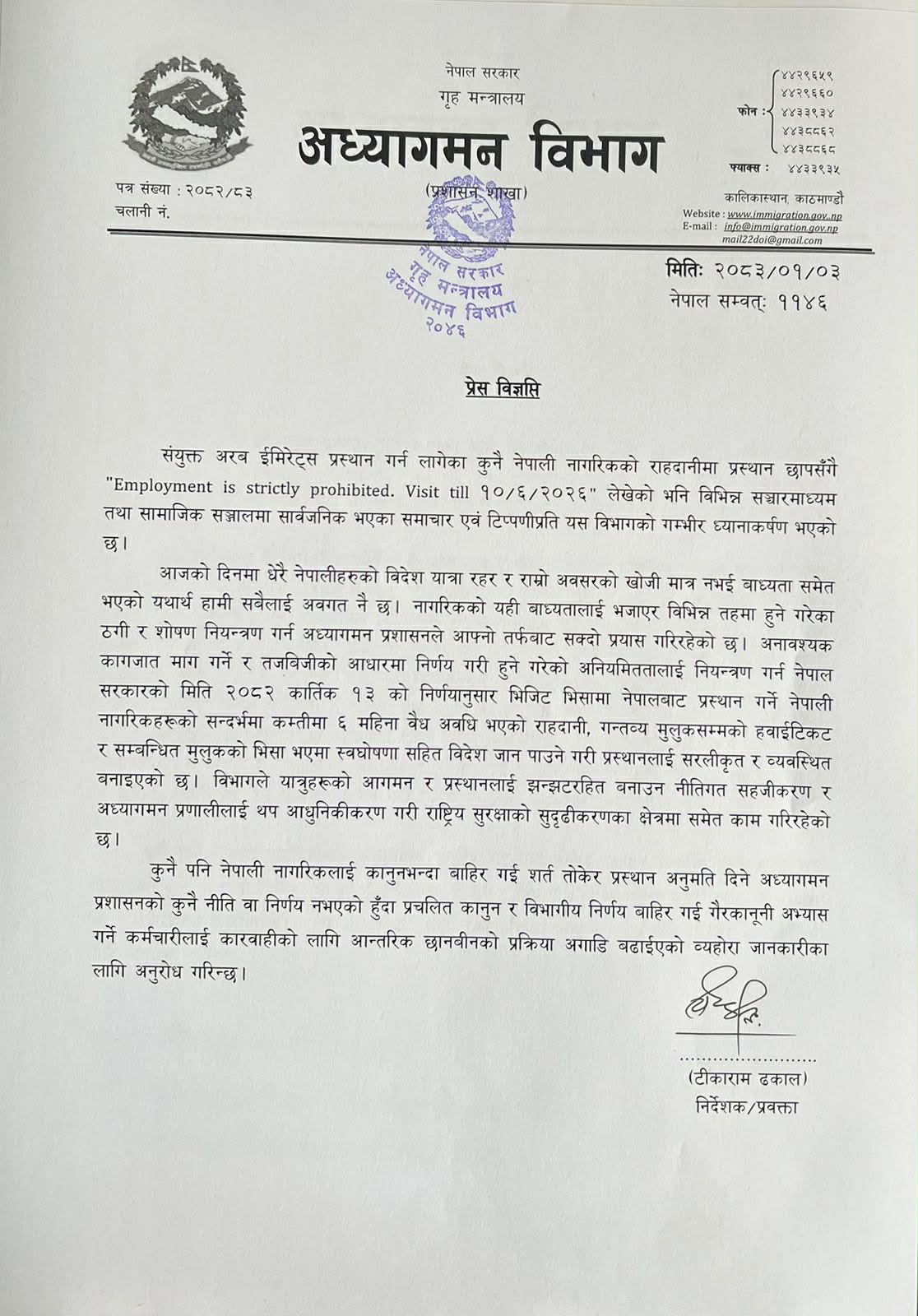
The department has said that it has drawn serious attention to this after a photo of a passenger’s passport with a departure stamp and the handwritten words ‘Employment is strictly prohibited. Visit till’ was made public on social media and various media outlets.
A press release issued by the department’s director and spokesperson, Tikaram Dhakal, said, “The immigration administration has no policy or decision to grant departure permission to any Nepali citizen beyond the law and by setting conditions.”
An internal investigation process has been initiated to take action against employees who engage in illegal practices that go beyond prevailing laws and departmental decisions. The Immigration Department has also clarified that the process of traveling abroad on visit visas has been further streamlined and simplified in recent times.
According to the decision of the Government of Nepal on October 30, Nepali citizens traveling on a visit visa can easily travel by making a ‘self-declaration’ if they have a passport with a validity of at least 6 months, a visa for the destination country, and a two-way air ticket, the department said in a statement. ‘The department is modernizing the policy-level facilitation and system to control fraud and exploitation that occurs by exploiting the compulsions of citizens.’ In such a situation, it is wrong for an employee to write unnecessary things in the passport based on personal preferences.’ The department has also stated that they are committed to making the movement of passengers hassle-free and strengthening national security.
The public had strongly criticized the employee on social media after he was seen to be ‘arbitrary’ with sensitive government documents like passports. Based on that criticism and public complaints, the department immediately began an investigation into the employee involved.






Comments